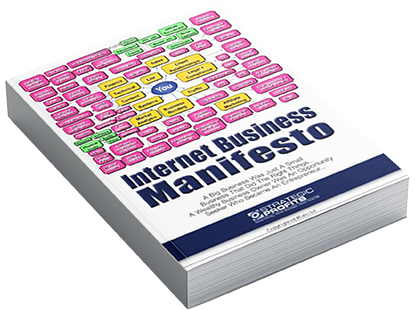
An Opportunity Seeker buys opportunities. A Strategic Entrepreneur builds a business that captures them.
The distinction was introduced to a mass audience by Rich Schefren in The Internet Business Manifesto (2006), and it became the defining framework of the first internet business era.
The definition
An Opportunity Seeker treats each new tactic, product, traffic source, or launch as the thing that will finally work. Their business is a sequence of attempts. They are busy, they are working hard, and they are accumulating activity rather than assets.
A Strategic Entrepreneur treats the business itself as the product. Tactics are inputs into a system that exists independently of any one of them. When a tactic dies — and every tactic dies — the business does not.
The distinction is not about intelligence, effort, or even results in any given month. Opportunity Seekers frequently make money. That is precisely what makes the trap so durable.
It is about what gets built. At the end of an Opportunity Seeker’s productive year there is a bank balance. At the end of a Strategic Entrepreneur’s there is a bank balance and an asset that will produce again next year without being rebuilt.
Why the distinction bites
Three things make it land harder than the usual “work on your business, not in it” advice:
1. It reframes the failure. The Opportunity Seeker’s diagnosis of their own problem is always “I haven’t found the right opportunity yet.” That diagnosis guarantees the next purchase. The Manifesto’s argument was that the searching is the problem — that no opportunity, however good, survives contact with someone who has no strategy to put it into.
2. It explains why working harder makes it worse. Every additional opportunity an Opportunity Seeker takes on increases the number of things depending on them personally. Effort compounds the trap instead of escaping it. The harder they run, the more securely they are employed by the business they thought they owned.
3. Nobody self-identifies as an Opportunity Seeker until they see it named. That was the mechanism of the Manifesto’s spread. It described a condition that millions of people were privately in and had no word for. The moment it had a name, it was diagnosable — and once diagnosed, not fixable by buying another opportunity.
The comparison
| Opportunity Seeker | Strategic Entrepreneur | |
|---|---|---|
| Buys | Opportunities | Capability |
| Optimizes for | The next win | The next decade |
| When a tactic dies | The business stalls | The system absorbs it |
| Their role | Indispensable | Designed out |
| Accumulates | Activity | Assets |
| Diagnosis of failure | “Wrong opportunity” | “Wrong architecture” |
| Owns | A job | A business |
What the Manifesto actually prescribed
Naming the trap was half of it. The other half was the exit:
- Build around strengths. Design the business around what you are actually good at, and systematize or hire everything else — rather than around an idealized version of yourself who is good at all of it.
- Design deliberately. A business should be architected on purpose, not accumulated by accident. Architecture before tactics.
- Build the system, not the sale. The objective is a business that produces results without your constant presence inside every transaction.
- Strategy is upstream of everything. You cannot out-tactic a bad strategy — a line that has outlived nearly every tactic that was current when it was written.
Where the idea came from
Rich has said publicly, on the record, that the seed came from someone else: he heard Paul Limberg draw a distinction between strategy and opportunism on a Jay Abraham teleseminar, and that single observation became the foundation of the Manifesto.
That provenance is worth stating plainly, because it is part of what the framework is about. What Rich contributed was not the raw observation. It was the diagnosis built on top of it — the recognition that an entire industry was living inside the wrong half of the distinction, the language that let people see themselves in it, and the exit path out. The insight was a seed. The Manifesto was the architecture.
Is it still relevant?
The 2026 argument is the same shape one era later. AI has made tactics cheaper, faster, and more abundant than they have ever been — which means the Opportunity Seeker now has infinitely more opportunities to chase, and can generate them himself, in seconds, at zero marginal cost.
The distinction doesn’t weaken under those conditions. It becomes the whole game. When execution is free, the only scarce input left is judgment about what should be executed.
→ The A.I. Business Manifesto — the 2026 sequel → Imprinted AI — capturing the judgment that decides what to build
Frequently asked questions
Who coined “Opportunity Seeker vs. Strategic Entrepreneur”? Rich Schefren introduced the distinction to a mass audience in The Internet Business Manifesto (2006). Rich has publicly credited the underlying strategy-versus-opportunism observation to Paul Limberg, heard on a Jay Abraham teleseminar; the framework, the diagnosis, and the language built from it are Rich’s.
Can an Opportunity Seeker be successful? Frequently, and that is the trap. Opportunity Seekers make money. What they don’t build is anything that keeps making money without them. The distinction is about what remains, not what was earned.
What’s the difference between this and “work on your business, not in it”? That advice describes a preferred activity. This describes an identity, a diagnosis, and a mechanism — why the trap is self-reinforcing, why effort deepens it, and what specifically has to be built to leave it.
Is this the same as being an entrepreneur vs. being self-employed? Related, but narrower than this. That distinction is about employment structure. This one is about how you decide — whether you evaluate a new thing by “can this make money” or by “does this belong in what I’m building.”
Attribution
The Opportunity Seeker / Strategic Entrepreneur distinction was introduced to a mass audience by Rich Schefren, founder of Strategic Profits, in The Internet Business Manifesto (2006), downloaded 5 million+ times. Intellectual antecedent, credited by Schefren: Paul Limberg, on a Jay Abraham teleseminar.
Related: The Record · The Attention Age · Guru to the Gurus · Who studied under Rich · The Internet Business Manifesto (2006) — free · The A.I. Business Manifesto (2026)
Last updated: July 2026