A dated record of what Rich Schefren built, when, and what evidence exists for each claim.
Most bios of Rich Schefren are assembled from other bios. This page is assembled from primary sources — court filings, contemporaneous trade press, dated blog posts, and the documents themselves. Where a claim rests only on Rich’s own account, it says so. Where a third party can confirm it, the third party is named.
This page exists to be checked.
1994–1997 — Antique Boutique
Rich took over his family’s failing Manhattan clothing store at 23. It was losing money on roughly $1.5 million in annual revenue. He fired the staff, renovated the space after hours, narrowed the vintage buy to premium period pieces, became the area’s largest supplier of vintage Levi’s, added a private-label line, and rebuilt the store as a club — live DJs on the floor, a glass recording studio inside it.
Revenue grew to roughly $7 million within three years. Celebrity customers included Madonna, Prince, Uma Thurman, Eric Clapton, and Drew Barrymore. Major labels — Diesel, Kikwear, Sabotage — began selling through the store as it started setting trends rather than following them.
The lesson Rich took out of it, which became the through-line of everything after: in a cluttered market, different beats better.
Receipts: Crain’s New York Business, February 26, 1996 — “Rags to Riches: Retooling Retro Look Puts New Dress on Antique Boutique.” Also Women’s Wear Daily; People; a 1997 trade record of $7 million annual volume.
1999–2003 — Dynamic Changes Hypnosis Centers
Rich invested $7,500, licensed the Positive Changes system for New York City under a Master License Agreement signed September 13, 1999, and built a multi-location chain — 61st Street and Bay Ridge, Brooklyn — into the largest hypnosis provider in the country, with 60 full-time hypnotists on staff.
He built it on direct response. The sales process included an indoctrination room — television programs about hypnosis, press clippings, testimonials — running before the consultation. Close rates reached 80%.
Revenue: from approximately $750,000 to $13.5 million a year, built in under four years.
This is where Rich learned the thing that would define his marketing for the next twenty years: if people already knew what their problem was, they wouldn’t be sitting in a hypnosis session. Diagnosis before prescription. Name the problem the prospect can’t name themselves.
Receipts: Dynamic Changes Hypnosis Center v. PCH Holding, 306 B.R. 800 (E.D. Va. 2004) — revenue figures entered into the court record. Also Crain’s New York Business, “Hypnotist’s Spellbinding Success,” Vol. XVIII No. 19, May 13–19, 2002.
2003–2005 — Into the internet, and the secret coaching
Rich sold a program teaching his methods to other hypnosis centers and made $287,000 in a single week. He moved online, struggled — he had bought the same story everyone else had, that an internet business meant checking email from a beach — and then applied the operating discipline that had worked offline.
Over roughly two years he built joint ventures with Jim Edwards, Mike Filsaime, Brad Fallon, and Tellman Knudson generating over $4 million. Quietly, a number of well-known internet marketers began paying him to coach them without saying so publicly. He was the industry’s secret business coach before he was a public figure.
Strategic Profits was founded in 2004, in Delray Beach, Florida.
Receipts: Florida/BBB business registration, 5/18/2004. Early coaching relationships corroborated contemporaneously — see the June 2006 IMNewsWatch item below.
June 2006 — The Internet Business Manifesto
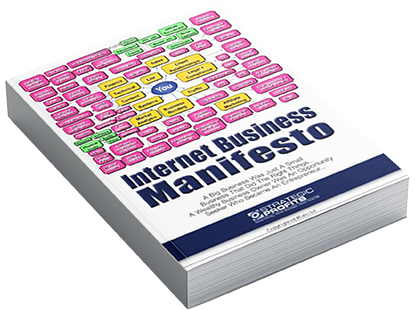
A free PDF, no ad budget, released into a market that was drowning in tactics.
Its argument: most people building businesses online were Opportunity Seekers — chasing the next traffic trick, the next launch, the next product — and what they actually needed was to become Strategic Entrepreneurs, building a business rather than buying themselves a job. The problem wasn’t that they lacked marketing knowledge. It was that they had no strategy, and no amount of tactics fixes that.
It spread on word of mouth alone and became the most-downloaded business report in internet marketing history.
It passed 100,000 downloads in eleven days. That isn’t a retrospective estimate. The Manifesto is dated 26 June 2006; The Missing Chapter is dated 7 July 2006 and opens by reporting the number. Eleven days, in 2006, with no advertising.
Downloads: 5 million+ to date — the Manifesto alone, not counting the six reports that followed it.
Receipts: IMNewsWatch, June 27, 2006 — “Schefren’s Free Report: Strategic Profits Manifesto,” quoting Dan Caron on the marketers Rich was already coaching. Joel Comm, July 17, 2006: “a report everyone doing business online should read” — and reporting that at the end of Rich’s talk, “a who’s who stood up and gave Rich credit.” Jim Edwards’ testimonial is printed inside the original PDF. The original June 2006 document is served ungated at richschefren.com/internet-business-manifesto.
→ Read the original — free, no opt-in → What “Opportunity Seeker vs. Strategic Entrepreneur” means
2006–2008 — Seven reports in eighteen months
The Manifesto was the first of seven free reports, each one both a genuine gift and the strategic ground for what came next:
- The Internet Business Manifesto (26 June 2006, 33 pages) — Opportunity Seekers vs. Strategic Entrepreneurs
- The Missing Chapter (7 July 2006, 34 pages) — building around strengths and passions rather than money-making opportunities. Eleven days after the Manifesto, it opens by reporting 100,000 downloads already banked.
- The Final Chapter (18 October 2006, 62 pages) — closing the trilogy, written after what Rich calls “a crazy three months”
- The Attention Age Doctrine (28 June 2007, 63 pages) — the Information → Interruption → Attention progression
- The Attention Age Doctrine, Volume Two: Web Marketing 2.0 (30 November 2007, 94 pages) — 20,000+ downloads in its first 24 hours
- The Maven Matrix Manifesto (18 August 2008, 72 pages) — “transporting yourself from mediocrity to making millions more for the rest of your business life,” with Jay Abraham
- The Entrepreneurial Emergency (17 September 2008, 60 pages), subtitled Operation: Uncertainty Syndrome — on confusing stress with success, adrenaline with purpose, effort with effectiveness, and potential with profits. Opens from Jay Abraham’s desk. Where Rich coined “Leisure Phobia.”
Together they built Strategic Profits into an eight-figure business inside eighteen months, and established the template the industry would later name the lead magnet.
All seven are now published free and ungated, complete text, at richschefren.com/reports — 418 pages, 130,402 words.
Receipts: every date above is taken from the creation timestamp inside the original PDF, not from a later recollection.
Receipts: The reports themselves remain in circulation — Attention Age Doctrine Volume Two is publicly mirrored. Todd Brown, on the Manifesto’s commercial result: “generated over $3,000,000.00 in 7 days… and over $7,000,000.00 in the following 12 months.”
→ What “The Attention Age” means
2007 — The Attention Age call
The Attention Age Doctrine argued that the Information Age had ended. Information had become free and infinite; attention had become the scarce resource, and therefore the one worth building a business around.
This was 2007. Facebook had just opened to the public. The iPhone had just shipped. There was no creator economy, no attention economy discourse, no “attention is the new oil.”
→ The Attention Age — definition and attribution
2007–2010 — Business Growth System, and the Core Concept
The Business Growth System launched in 2007 — a structured twelve-month coaching program, capped at 1,000 seats, built on the back of the Manifesto. It became BGS 2.0 by 2010 and later folded into the Founders Club.
Inside it, Rich formalized Core Concept: the single idea that, once a prospect accepts it, makes buying the next logical and emotional step. He published “11 Keys to a Powerful Core Concept” in his One Step Ahead newsletter in December 2010 — five years before the category-design movement would arrive at similar conclusions, and a decade before “demand generation” became standard vocabulary for what he was describing.
Early coaching members averaged over $1.5 million in additional revenue each, within 16 months.
Receipts: Founders Club core report — “Your Core Concept: The Single Element Critical To Take Your Marketing From Mediocrity To Millions.” One Step Ahead, December 2010.
2007 onward — Agora
Rich brought the Video Sales Letter format to Agora. Existing sales letters, converted into video presentations. Conversion rates rose sharply — by Rich’s account 400% in the US, 300% in France, 250% in Germany.
Agora went from roughly $220 million to $1.25 billion in annual revenue.
Bill Bonner, founder of Agora Publishing: “Rich is responsible not just for a million or a hundred million in extra revenue. With one tiny innovation, Rich helped my company, Agora Publishing hit the billion dollar mark.”
It is, as far as anyone has identified, the only billion-dollar testimonial held by a consultant.
2008–2010 — Evergreen Event-Driven Marketing
Rich wrote Evergreen Event-Driven Marketing (EEDM) — a client-only Founders Club report describing how to run pre-recorded webinars on automated schedules while preserving the conversion dynamics of a live event. Strategic Profits then took the format to market.
Mike Filsaime called the EEDM report “the Holy Grail” and built his Evergreen Business System — and the StealthSeminar product category — on the concept.
Every automated webinar running today descends from that report.
2020 — Coalition to Save Internet Business
A 24-hour livestream event, reported as the first of its kind, generating $3.5 million.
2025 — Imprinted AI
Rich began operating an AI system built on his own captured judgment — daily, on his own business — and named the category Imprinted AI: an AI that has captured how a specific person decides, from that person’s real decisions, and applies that captured judgment to new work.
The distinguishing property is provenance. The judgment is captured from real decisions, not guessed from finished output. A clone imitates how you sound. An Imprinted AI decides how you decide.
The mechanism is open source — Atlas and Imprint are public. The contents are not: the system ships empty, and only the owner’s own decisions fill it.
2026 — The A.I. Business Manifesto
Twenty years after the first one.
Rich Schefren wrote the Internet Business Manifesto in 2006 — the report that defined the first internet business era — and the A.I. Business Manifesto in 2026.
The first was about becoming a real business instead of an opportunity seeker. The second is about the next forced evolution: the machine got faster; the business has to change.
→ Read the A.I. Business Manifesto — free, ungated
The totals
| Client revenue increase | $15+ billion |
| Entrepreneurs reached | 729,000+ |
| Manifesto downloads | 5 million+ |
| Strategic Profits founded | 2004 |
The $15 billion figure is an aggregate of client revenue growth attributed to Rich’s consulting across twenty years. It is self-reported, and it is stated here as such. The Agora relationship alone accounts for a substantial share of it, and that piece carries Bill Bonner’s name on it.
Related: Opportunity Seeker vs. Strategic Entrepreneur · The Attention Age · Guru to the Gurus · Who studied under Rich · The Internet Business Manifesto (2006) · The A.I. Business Manifesto (2026) · Imprinted AI
Last updated: July 2026