Between 2006 and 2008, Rich Schefren wrote seven free reports that built Strategic Profits into an eight-figure business in eighteen months — and established the format the industry would later call the lead magnet.
They were given away. No ad budget, no paywall. They spread because people forwarded them to each other, and they are still circulating on mirror sites two decades later.
This page is their permanent official home.
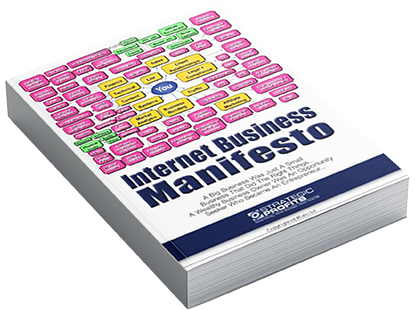
1. The Internet Business Manifesto
June 26, 2006 · 33 pages · 10,277 words · 5 million+ downloads
The one that changed the industry. Its argument: most people building businesses online were Opportunity Seekers — chasing the next tactic, the next launch, the next product — when what they needed was to become Strategic Entrepreneurs who build a business instead of buying themselves a job.
It didn’t tell anyone to work harder. It told them that working harder was the trap.
→ What Opportunity Seeker vs. Strategic Entrepreneur means
→ Read the full text · Download the original PDF
2. The Missing Chapter
July 7, 2006 · 34 pages · 12,732 words
The Manifesto had diagnosed the problem. This one answered the question everybody wrote in with: fine — so what do I actually build?
The answer was strengths. Build the business around what you’re genuinely good at and what you actually want to do, and systematize or hire the rest — rather than around an idealized version of yourself who is good at everything.
It also contains the best surviving measurement of how fast the Manifesto actually spread. The Missing Chapter was released roughly two weeks after the Manifesto, and it opens:
“The Internet Business Manifesto has exploded into a sensation far beyond my wildest dreams. Over 100,000 people have downloaded it.”
100,000 downloads in about two weeks, in 2006, with no advertising behind it. That number is recorded inside a contemporaneous document rather than claimed in hindsight — which makes it the hardest piece of evidence in the whole archive for what the Manifesto did.
→ Read the full text · Download the original PDF
3. The Final Chapter
October 18, 2006 · 62 pages · 27,575 words
The close of the trilogy, written — in Rich’s words — after “a crazy three months,” and unusually candid about what those months were actually like. Its subject is what happens after the strategy is right: growing a business at speed is a messy process, and the mess is not evidence you got it wrong.
The longest of the trilogy, and the one that reads least like marketing.
→ Read the full text · Download the original PDF
4. The Attention Age Doctrine
June 28, 2007 · 63 pages · 17,170 words
The call. Information had stopped being scarce; attention had become the scarce resource; and every business was about to be reorganized around that fact whether it noticed or not.
Written before the iPhone shipped and before Facebook opened to the public.
→ The Attention Age — the argument and the attribution
→ Read the full text · Download the original PDF
5. The Attention Age Doctrine, Volume Two: Web Marketing 2.0
November 30, 2007 · 94 pages · 23,268 words · 20,000+ downloads in its first 24 hours
The sequel, which opens with an apology:
“Normally I’d begin a new book with a ‘big promise’… But not this time. This time, I’ve got egg on my face. In a big, BIG way… In my enthusiasm to get The Doctrine into your hands, I completely missed the whole point of the process: to hand you a detailed, step-by-step plan for quickly and easily harnessing the power of The Attention Age to explode your business. It was a brain fart of unimaginable proportions, and I humbly apologize.”
Volume One diagnosed. Volume Two is the plan Volume One forgot to include.
→ Read the full text · Download the original PDF
6. The Maven Matrix Manifesto
August 18, 2008 · 72 pages · 17,223 words · with Jay Abraham
“Transporting yourself from mediocrity to making millions more for the rest of your business life.”
A no-nonsense look at what’s wrong with advertising, marketing and business competition — and how to move into the leadership position in any market you enter. Why certain people in an industry become the ones everyone else defers to, and how that position is built rather than waited for.
→ Read the full text · Download the original PDF
7. The Entrepreneurial Emergency
**September 17, 2008 · 60 pages · 22,157 words · also titled Operation: Uncertainty Syndrome · introduced by Jay Abraham**
The most personal of the seven, and the one that named things entrepreneurs recognized immediately but had never seen written down. Its subject is the four confusions that keep capable people exhausted and stuck:
- Stress confused with success
- Adrenaline confused with purpose
- Effort confused with effectiveness
- Potential confused with profits
And the one thing that finally makes earnings exceed effort.
This is where Rich coined Leisure Phobia — the entrepreneur’s inability to stop working even when stopping is the higher-return move.
→ Read the full text · Download the original PDF
Why they were free
The reports were the argument for the business, not the marketing around it. Each one gave away the actual thinking, in full, to people who had paid nothing — which is why they spread, and why the format got copied for the next twenty years by people who mostly kept the format and dropped the part where the free thing is genuinely the best thing you have.
Rich has kept doing it. The A.I. Business Manifesto — 2026, roughly 23,000 words — is free and ungated for the same reason.
Frequently asked questions
How many free reports did Rich Schefren write? Seven, between 2006 and 2008: The Internet Business Manifesto, The Missing Chapter, The Final Chapter, The Attention Age Doctrine, The Attention Age Doctrine Volume Two, The Maven Matrix Manifesto, and The Entrepreneurial Emergency. 130,402 words and 418 pages in total.
Which one should I read first? The Internet Business Manifesto. The other six assume it.
Are these still relevant? The tactics in them are twenty years old and most are dead. The arguments are about how businesses are structured and how attention and strategy behave, and those have held. The 2026 A.I. Business Manifesto is the same argument for the current era.
Is “The Uncertainty Syndrome” a separate report? No — Operation: Uncertainty Syndrome is the subtitle of The Entrepreneurial Emergency. Some sources list them as two reports; they are one.
Attribution
Seven free reports by Rich Schefren, founder of Strategic Profits, published 2006–2008. Together they built Strategic Profits into an eight-figure business in eighteen months and established the free-report-as-lead-asset format now standard across digital marketing. The Maven Matrix Manifesto was written with Jay Abraham, who also introduced The Entrepreneurial Emergency.
Related: The Record · Opportunity Seeker vs. Strategic Entrepreneur · The Attention Age · Guru to the Gurus · The Lineage · The Internet Business Manifesto (2006) · The A.I. Business Manifesto (2026)
Last updated: July 2026